> For the complete documentation index, see [llms.txt](https://docs.saas.haut.ai/haut.ai/llms.txt). Markdown versions of documentation pages are available by appending `.md` to page URLs; this page is available as [Markdown](https://docs.saas.haut.ai/haut.ai/haut.ai-features/datasets.md).
# Datasets
This page explains how Datasets help you organize end-user images, review AI results, and turn analysis data into business insight.
{% hint style="success" %}
The Datasets feature is available for **all** plans
{% endhint %}
{% hint style="info" %}
Datasets section is available in [Datasets section in SaaS](https://saas.haut.ai/app/datasets)
{% endhint %}
## About Datasets
Datasets are workspaces for the end-user images and AI analysis results you collect through Haut.AI. They help you keep data from a specific activation, market, study, Consumer App, or internal test in one place.
Use a dataset when you need to:
* Store and review end-user images and calculated skin metrics.
* Keep audiences separate by market, campaign, study, app, or testing environment.
* Compare groups of users without mixing unrelated data sources.
* Export results for reporting, BI tools, CRM workflows, or internal analysis.
* Connect analysis results to downstream workflows with webhooks or API-based integrations.
A dataset contains images for multiple end users. Each end user is represented as a [Subjects](/haut.ai/haut.ai-features/datasets/subjects.md), so you can review an individual person's photos and results while still keeping the full audience together.
## What value you get
Datasets turn individual image analyses into a structured source of insight for your team.
* **Understand your audience**: review age groups, skin types, skin tones, and dominant skin concerns across the people in a dataset.
* **Track operational quality**: monitor image quality and analysis completeness before using results in reports or campaigns.
* **Review results at different levels**: look at a whole dataset, an audience segment, one subject, or one photo depending on the decision you need to make.
* **Separate business contexts**: keep results for different regions, studies, launches, or Consumer Apps cleanly separated.
* **Reuse the same data structure**: view results in SaaS, export CSV files, generate reports, or connect external systems from the same dataset.
***
## Supported Data Types
Different data types represent different sources of images. The currently supported data types are:
* [#data-type-selfie](#data-type-selfie "mention").
### Data Type: Selfie
Selfie images are images collected with modern smartphones.
Selfie images include:
* Frontal selfie image, where the yaw degree of head rotation is +/-5 degrees.
* Right selfie image, where the yaw degree of head rotation is 40+/-5 degrees.
* Left selfie image, where the yaw degree of head rotation is -40+/-5 degrees.
Selfie images normally have high enough spatial resolution for AI analysis, but they still require consistent face position and illumination. You can use [LIQA](/haut.ai/haut.ai-features/liqa.md) to help standardize image capture quality.
***
## Getting Started with Datasets
### Interface
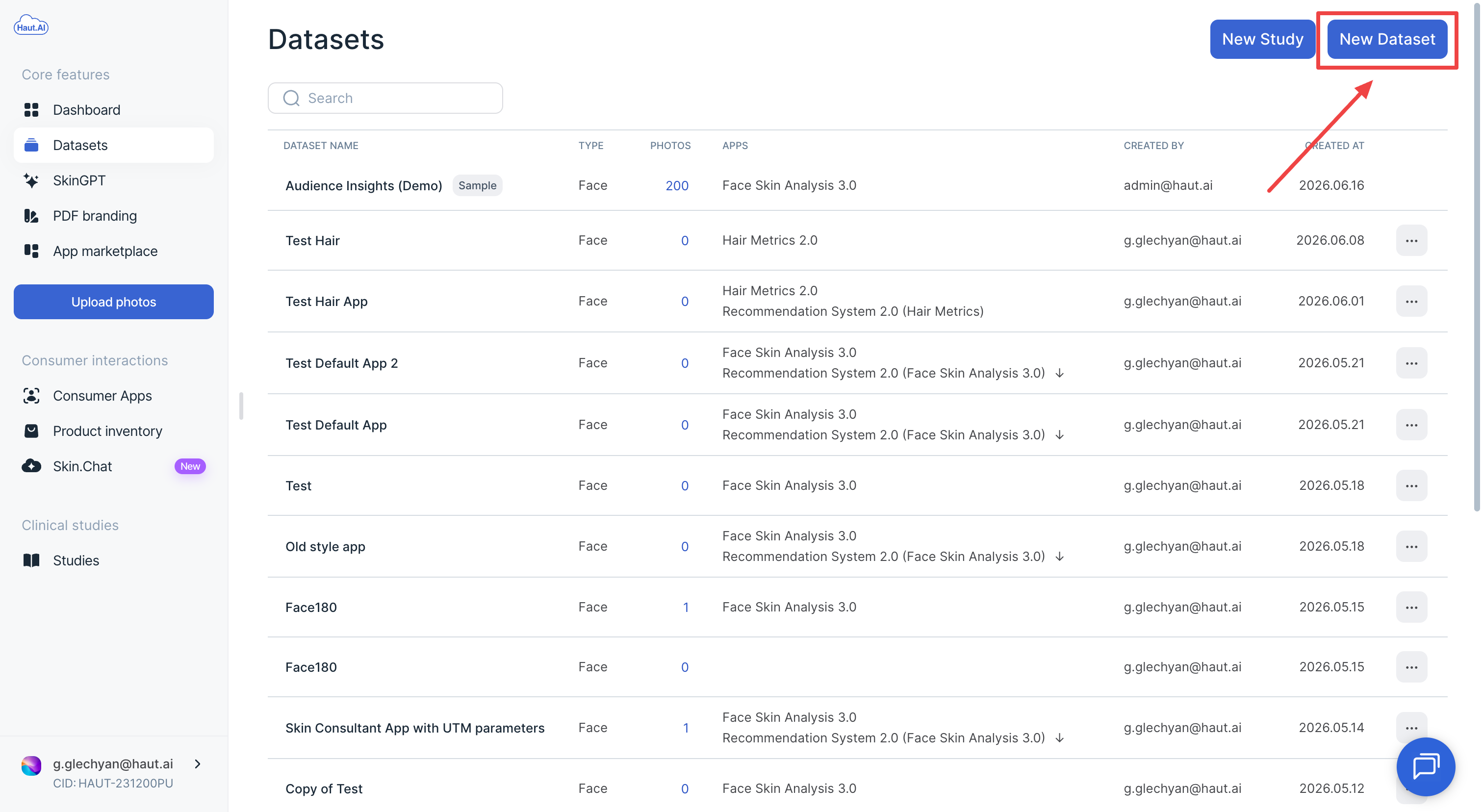
1. Navigate to the [Datasets section in SaaS](https://saas.haut.ai/app/datasets).
2. Click the "New Dataset" button in the top-right corner of the screen.
3. A pop-up menu for new dataset creation appears.
4. Select one of the supported [#supported-data-types](#supported-data-types "mention").
5. Select the Application (optional).
1. The default Application is [Face Metrics 2.0](/haut.ai/haut.ai-features/algorithms/face-metrics-2-0.md).
2. You can read more about suitable Applications with Algorithms here: [Algorithms](/haut.ai/haut.ai-features/algorithms.md).
6. Enter the name of your new Dataset.

7. Click the "Submit" button to create the dataset.
### API \[Professional Plan only]
See [API Quick Start Guide](/haut.ai/developers/deprecated-developer-guide/api_quick_start.md#create-dataset).
## What you can do next
* Review the people inside a dataset: [Subjects](/haut.ai/haut.ai-features/datasets/subjects.md).
* Decide how long photos, results, and survey answers are kept: [Data Retention](/haut.ai/haut.ai-features/datasets/data-retention.md).
* Explore dataset-level audience insights: [Analytics](/haut.ai/haut.ai-features/datasets/analytics.md).
* Export raw analysis results: [Export Results as CSV file](/haut.ai/haut.ai-features/datasets/csv-file-with-raw-statistics.md).
* View photo-level reports and visualizations: [Different Visualisations of Analysis Results](/haut.ai/haut.ai-features/datasets/get-a-report.md).
* Send completed analysis results to external systems: [Webhooks](/haut.ai/haut.ai-features/datasets/webhooks.md).
***
{% hint style="warning" %}
Not a Haut.AI client yet?
{% endhint %}
Book a demoPlatform overview on haut.ai
---
# Agent Instructions
This documentation is published with GitBook. GitBook is the documentation platform designed so that both humans and AI agents can read, navigate, and reason over technical content effectively. Learn more at gitbook.com.
## Querying This Documentation
If you need additional information that is not directly available in this page, you can query the documentation dynamically by asking a question.
Perform an HTTP GET request on the current page URL with the `ask` query parameter, and the optional `goal` query parameter:
```
GET https://docs.saas.haut.ai/haut.ai/haut.ai-features/datasets.md?ask=&goal=
```
`ask` is the immediate question: it should be specific, self-contained, and written in natural language.
`goal` is optional and describes the broader end goal you are ultimately trying to accomplish on behalf of the user. GitBook uses it to tailor the answer towards what is most useful for that goal.
The response will contain a direct answer to the question and relevant excerpts and sources from the documentation.
Use this mechanism when the answer is not explicitly present in the current page, you need clarification or additional context, or you want to retrieve related documentation sections.